
Key milestones First live network Fall 2026 USPTO provisional filed 2026 U.S. debut · SXSW Austin March 2027 Non-provisional / PCT 2027
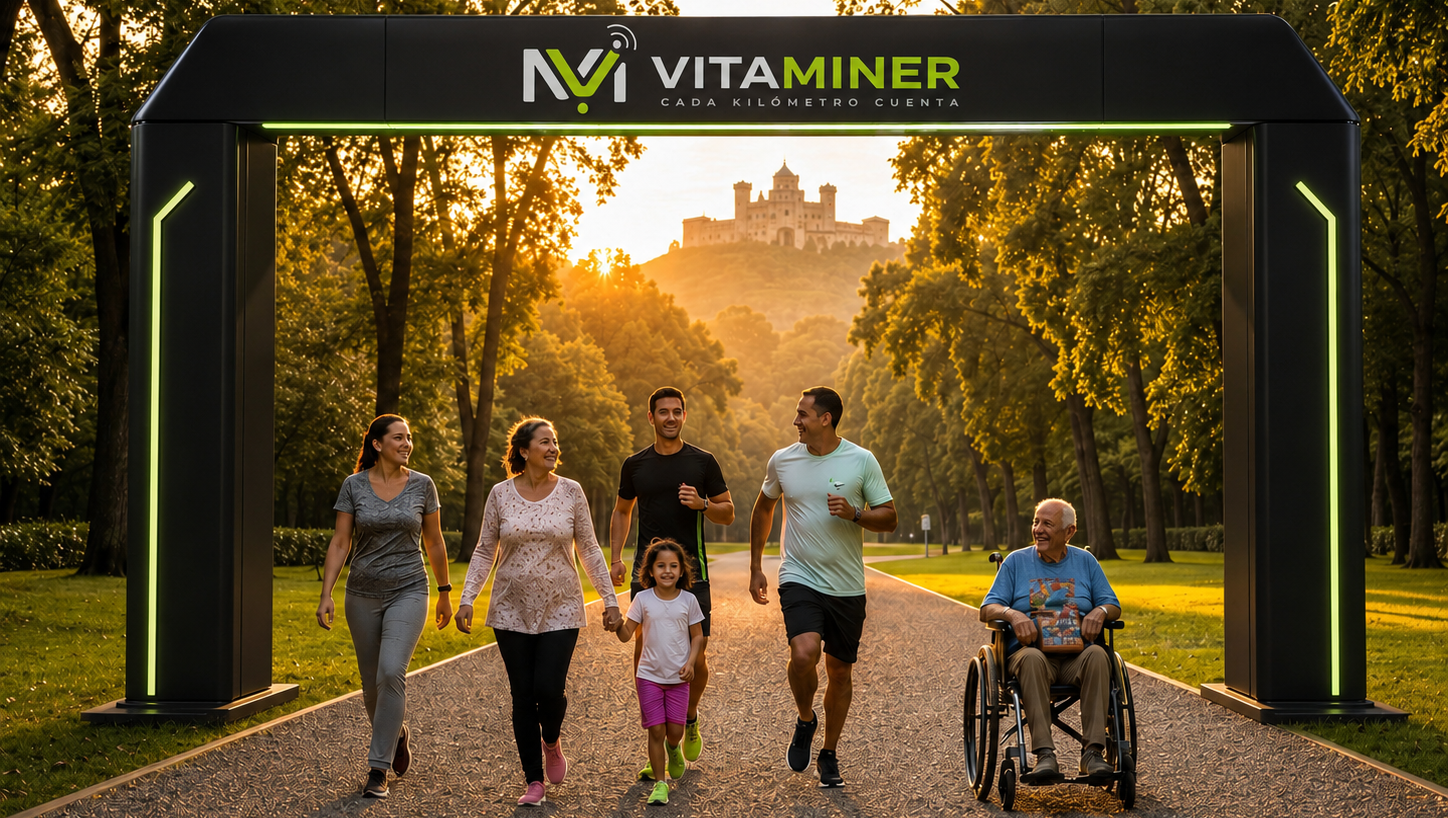
VitaMiner checkpoint arch in a public park at dawn
Proof of Effort Protocol

The city that counts.

VitaMiner turns walking into verified, fraud-proof data. Solar-powered arches read a battery-free wristband as people pass — crediting every real kilometer to a live public count. No apps. No cameras. No batteries. No surveillance.
Patent pending · USPTO No app required No camera No battery No surveillance Aggregate-only public data
Why it matters

Physical activity is a public-health priority.
Nobody could prove it was happening.

Cities invest in parks and wellness programs, then rely on self-reported apps and surveys — data that is spoofable and excludes the people who need these programs most. VitaMiner replaces declaration with measurement.

0
actions required from the participant to earn a kilometer
0
batteries in the credential — years of life, no charging
100%
hardware-verified events, sealed in a tamper-evident record
inclusion — works for people without a smartphone
How it works

Three steps. The participant does nothing.

1

Receive the credential

A single-color silicone wristband with a passive UHF chip — no battery, no screen, no pairing. It lasts for years and works for anyone, including people without a smartphone.

2

Walk through the arch

Two spatially separated antenna groups read the wristband and determine direction of travel — so walking back and forth doesn't count. No stopping, no scanning, no friction.

3

Kilometers are credited

An anti-fraud engine validates speed, deduplicates, and detects clusters, then seals each passage in a tamper-evident record. Aggregates feed a live public counter.
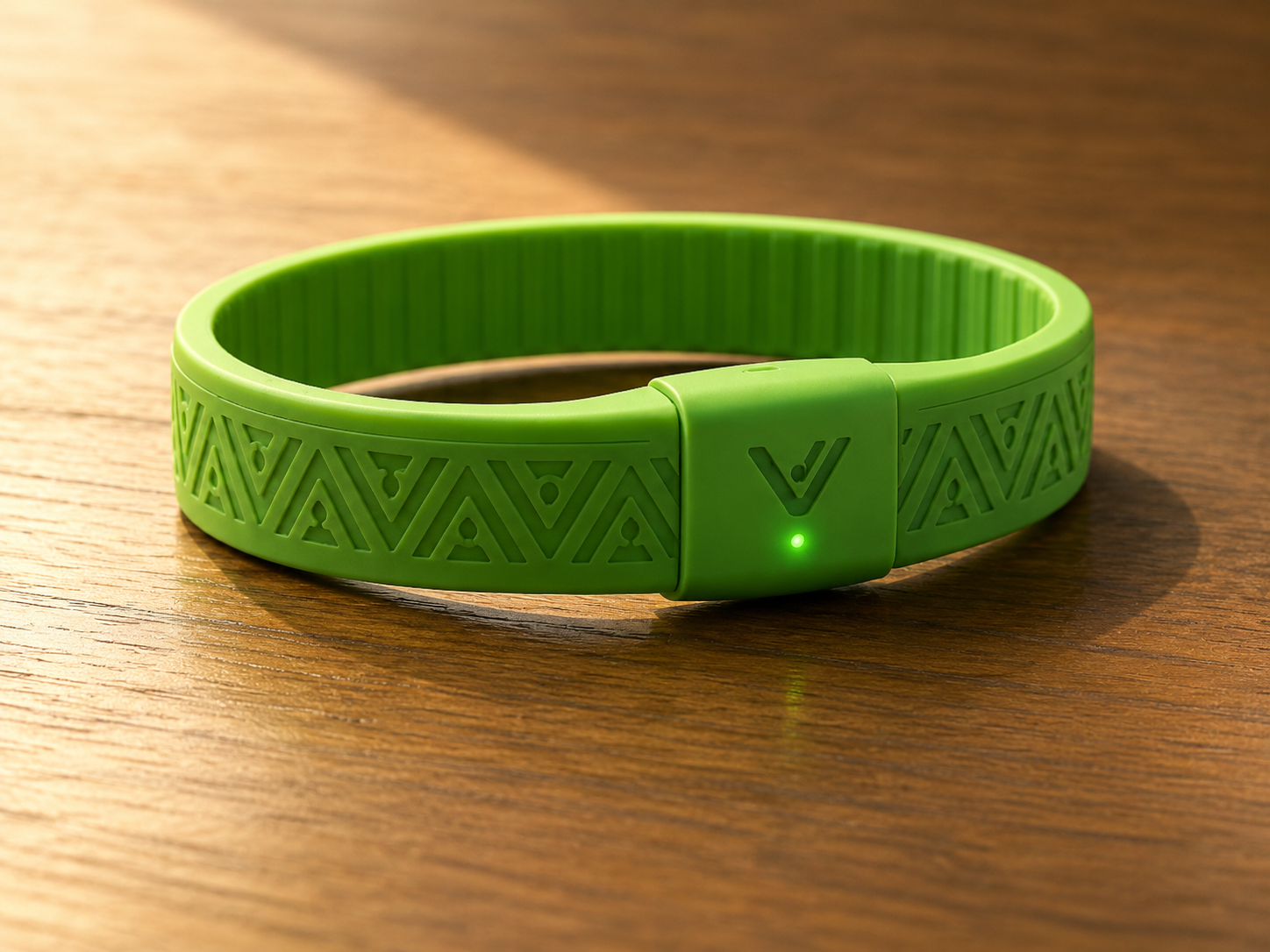
VitaMiner passive silicone credential
Why it's different

Surveillance-free verification.

Every wellness incentive today runs on self-reported data — phones and wearables that live in the participant's pocket and can be faked. VitaMiner moves the measurement outside the participant's control.

  • Third-party hardware oracle. Evidence is produced by infrastructure the participant doesn't own — the passage itself becomes the proof.
  • Tamper-evident audit. Each event is hash-chained, so public funding can be audited without a central custodian of raw data.
  • Privacy by design. Credentials carry no personal data. Public outputs are aggregate — people and kilometers, never identities. No biometrics, no facial recognition.
  • Inclusive by default. No app, no battery, no smartphone required — the elderly and disconnected are first-class participants.
The anti-fraud engine

The kilometer defends itself.

↔️

Direction by antenna order

Two separated antenna groups read the credential in sequence, so only forward traversal counts. Reversing or idling earns nothing.

Impossible-speed rejection

Passages implying transit faster than physically possible between known checkpoints are rejected automatically.

👥

Co-migration detection

One person carrying many credentials shows up as a co-migrating cluster and is flagged for review.

🔁

Deduplication windows

Repeated reads inside a temporal window collapse into a single credited event, bound to the chip's inventory state.

🔒

Offline-first

If connectivity drops, checkpoints keep reading and sync without losing events when the network returns.

🧾

Daily caps

Per-account and per-node caps bound credit, keeping the system fair and fundable at scale.

Deployment

Fixed arches. Mobile kits. One platform.

Deploy a permanent network of checkpoints, bring mobile kits to events, or both — all feeding one city-wide counter and one accreditation engine.
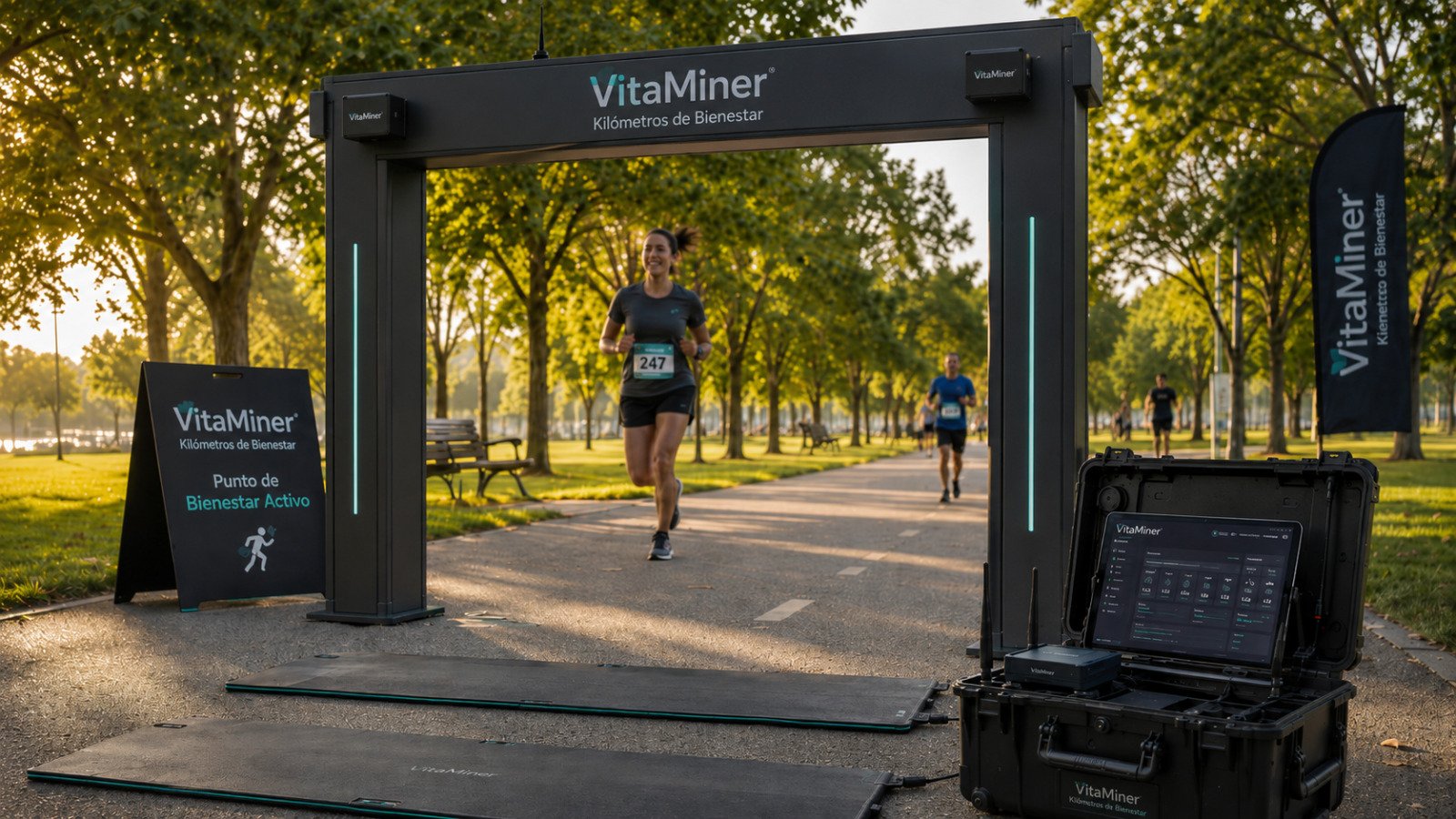
  • Permanent arches — solar-powered, weather-sealed, vandalism-resistant, installed along walking circuits and parks.
  • Mobile checkpoint kits — ground mats and folding panels that deploy in minutes for races, festivals, and pop-up events.
  • Program layer — funders set incentive rules before capital moves; the engine enforces them with no human discretion.
  • Public counter — a live, aggregate display of people and kilometers that makes civic effort visible.
VitaMiner mobile checkpoint kit
Inclusion

Everyone counts. Especially the forgotten.

App-based wellness programs silently exclude the elderly, the disconnected, and the digitally underserved — the very people public-health programs exist to serve.

  • No smartphone required. The credential is the whole interface.
  • No digital literacy required. Walk through the arch — that's the entire interaction.
  • Multilingual onboarding. Registration flows designed for community programs in any language.
"What isn't measured with instruments is merely believed. What is measured with instruments is known. VitaMiner measures who moved."
VitaMiner · Proof of Effort Protocol
Roadmap & deadlines

Where we are, and what's next.

2026 · Done

USPTO provisional filed

The Proof of Effort Protocol is protected by a patent application pending with the USPTO. Priority secured.

Fall 2026

First live network

The first permanent VitaMiner checkpoint network goes live in Mexico, producing the first verified public kilometer counts.

March 2027

U.S. debut at SXSW, Austin

A verified-kilometer community run in an Austin public park, presented with the Mexican community during SXSW 2027.

2027

Non-provisional & PCT

Filing the non-provisional application and PCT to extend protection internationally, timed with field evidence from live deployments.

2027–2028

Multi-city expansion

Circuit-by-circuit deployment across Latin America, the Gulf region, and the United States, each venue branded to its city.

Bring a counting city to life.

For city governments, parks & recreation departments, health programs, and funders who want wellness they can actually verify.